

| 900/1200 mm | 900 mm | |
| Articel number: | 10600 | 10400 |
| Max load: | 500 kg | 500 kg |
| Width: | 720 mm | 720 mm |
| Length: | 2025 mm | 2025 mm |
| Height: | 1470 mm | 1310 mm |
| Weight: | 100 kg | 85 kg |
| SRA-code: | 161113 | 161113 |
| Working height: | 870 mm | 870 mm |
The table for both transport and adaptation of materials
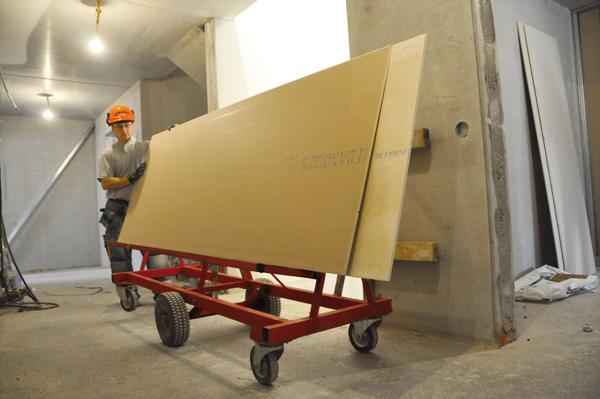
The Transit Bench has an important place in the plasterboard processing flow, facilitating transport of your plasterboard to the installation site. Additionally you can use the Transit Bench’s surface for cutting your plasterboard on the spot, before it is moved to the Board Lifter for installation.
The table for both transport and adaptation of materials
The transit Bench plays a central role in the plasterboard handling workflow, making it easier to transport plasterboard from trestles to the installation site. It creates a more efficient and structured workflow where material handling, cutting, and installation are seamlessly connected.
Additionally, you can use the Transit Bench’s surface for cutting your plasterboard directly on site before it is moved to the Board Lifter for installation. This allows the same unit to function both as a material trolley and a mobile work table, reducing unnecessary handling steps and improving productivity.
The ergonomic and flexible design gives your workplace a more thought-out concept, saving both time and effort for your staff. Workers can use the sheet cart for transport, while also benefiting from a stable work surface for on-site adaptation of materials.
Keep your workflow efficient with the Transit Bench, combining transport and processing in one smart solution. It is easily handled and designed to move plasterboard smoothly between different work stages on site.
Scope of use
The Transit Bench’s function is to enable workers to move plasterboard in a simple and efficient way from the Plasterboard Trestles to the installation site. Thanks to its clever design, the Transit Bench can also be used to cut and adapt plasterboard materials directly on site before installation.
Its stable tubular steel construction supports up to 500 kg of plasterboard, or approximately 20 sheets. This makes it a reliable heavy-duty material trolley / board trolley for demanding construction environments.
You can switch between horizontal and vertical positions depending on the application:
- In the horizontal position, the four smaller wheels and built-in support legs automatically come down, giving increased stability when processing plasterboard. This transforms the unit into a secure mobile worktable.
- When transporting the trolley, it folds into a vertical position and uses easy-rolling pneumatic wheels. The trolley then becomes very narrow and manoeuvres easily through tight passages and over uneven surfaces.
Ergonomic workflow and efficiency
The Transit Bench combines transport and adaptation of materials in one integrated system. This reduces unnecessary lifting, improves workflow efficiency, and ensures that materials can be handled closer to where the work is actually performed.
By allowing cutting, adjustment, and transport in one unit, it creates a smoother and more ergonomic working process for construction teams. The result is less wasted time, fewer movements, and a more efficient jobsite workflow.

Frequently Asked Questions
What is the purpose of a plasterboard trolley on a construction site?
The plasterboard trolley is a central part of the drywall handling process. It simplifies the transport of materials from trestles to the installation area and can also be used as a workbench for cutting and adjusting boards on site. By keeping handling at waist height, it creates a more efficient and ergonomic workflow.
How does it improve ergonomics on site?
The flexible design allows you to switch between horizontal and vertical positions depending on the task. In horizontal mode, support legs and smaller wheels provide extra stability during material processing.
For transport, the vertical mode uses durable, easy-rolling ERGO wheels (with a 5-year warranty), making the trolley manual handling smooth and controlled — even in tight spaces or on uneven ground.
What are the benefits of using it as a workbench?
Using the trolley as a work surface allows you to cut and adjust plasterboard directly where the work happens. This reduces unnecessary movement and enables multiple tasks to be completed in one place — saving both time and energy.
What is the load capacity?
The trolley is designed to carry up to 500 kg, which corresponds to approximately 20 plasterboard sheets. This makes it a reliable heavy duty material trolley for both transport and processing.
How easy is it to maneuver?
Equipped with durable ERGO wheels, the trolley rolls smoothly even over rough or uneven surfaces. The ability to switch between transport and work modes ensures maximum flexibility on site.
How does it improve workflow efficiency?
By combining transport and material processing into one unit, the board trolley significantly streamlines the workflow. It reduces unnecessary movement, improves coordination between work steps, and helps create a more efficient and connected construction process.


